Public address system: analogue or network speakers
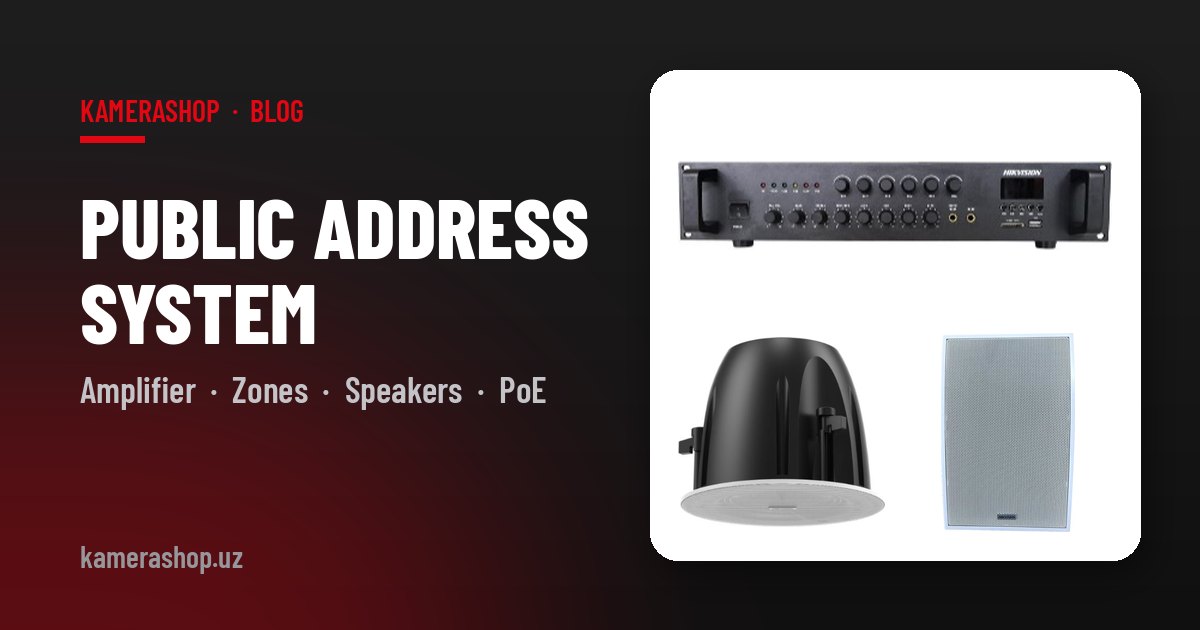
A public address (PA) system is a network of speakers for announcements, background music and warnings across a building. Schools and kindergartens use it for bells and announcements, malls and shops for background music, warehouses and factories for paging staff, car parks for warnings. There are two kinds: analogue and network (IP).
Analogue system: amplifier and speakers
An amplifier sits at the centre with a microphone and music source connected, and the speakers are driven from it over wires. To reduce losses on long runs these systems usually use a 100 V line, with many speakers connected in parallel on one line.
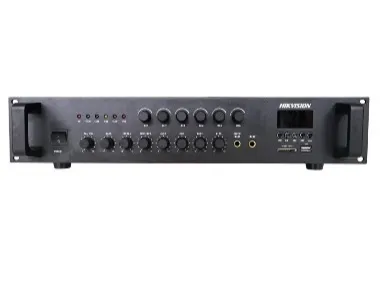
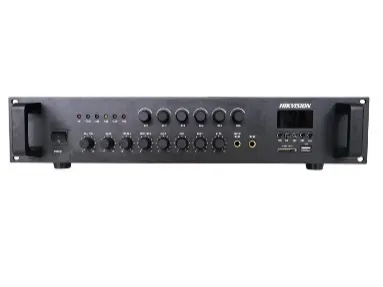
- Amplifiers: DS-QAE0A60G1-VB (60 W), DS-QAE0A120G1-VB6 (120 W, 6 zones), DS-QAE0A240G1-VB6 (240 W, 6 zones), the wall-mounted DS-QAE0A40G1W-RB (2×20 W).
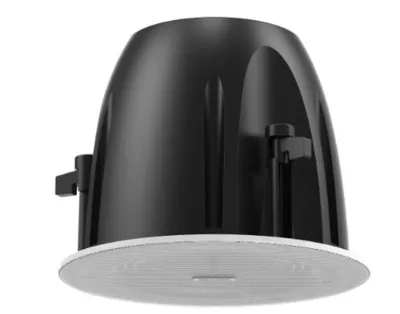
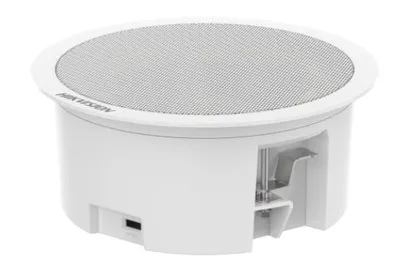
- Speakers: ceiling — DS-QAE0210G1-V (10 W), wall cabinet — DS-QAE0120G1E-V (20 W), column — DS-QAE0420G1-V (20 W).
- Desk microphone for announcements: DS-QAE0MG0G1 (gooseneck paging microphone).
Pros: simple, reliable, no computer or network required. Cons: each zone needs its own line, and expansion means new wiring.
How to size the amplifier
Add up the power of all speakers and keep 20–30% in reserve. Example: 10 ceiling speakers × 10 W = 100 W; with reserve you need 120–130 W, so a 120 W amplifier would run at its limit, while the 240 W DS-QAE0A240G1-VB6 leaves room for more speakers later. Speakers often have selectable power taps (for example full or half power) — use the selected value in your calculation.
Why zones matter
A zone is a separately controlled group of speakers: a floor, a classroom, a hall, a warehouse or an outdoor area. With a 6-zone amplifier you can announce to the second floor only, or only to the warehouse, and play music in the sales hall while the office stays quiet. When designing, split the building into zones first, then count speakers for each.
Network (IP) system: every speaker is a network device
A network speaker connects with an ordinary LAN cable, and many take power over the same cable via PoE. No separate audio line is needed: a speaker can go anywhere the network reaches, and zones are set in software.
- Ceiling: DS-QAZ1203G1-BE (3 W), DS-QAZ1206G1-BE (6 W), the frameless DS-QAZ1630G1-BE (PoE, 30 W);
- Wall cabinet: DS-QAZ1110G1R-BE (PoE, 10 W); column: DS-QAZ1460G1 (60 W);
- Outdoor horn: DS-QAZ1325G1T-E (PoE, 25 W);
- Network amplifiers to bring analogue speakers onto the network: DS-QAE1A80G1-VB (80 W, 2 zones), DS-QAZ1A500G1-VB2 (500 W, 2 zones).
PoE speakers need a PoE switch, and its power budget must be calculated: how to choose a PoE switch.
Combined with CCTV: voice warnings
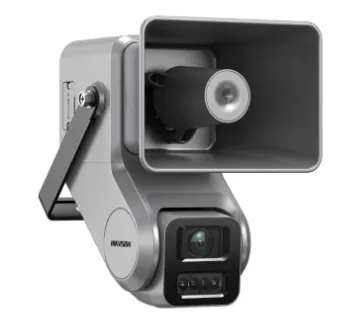
Hikvision also makes a camera and speaker in one device: the DS-QACAM07G1-4LIZSU, a 7 W motorised horn with a 4 MP camera. When the camera sees a person in the area, the speaker plays a warning straight away — useful for car parks, warehouse yards and building sites. Ordinary cameras can also trigger a network speaker through the recorder.
Analogue or network: which to choose
| Criterion | Analogue | Network (IP) |
|---|---|---|
| Cabling | Separate audio line | Existing LAN |
| Zones | Limited by the amplifier's zones | In software, almost unlimited |
| Expansion | New wiring | Just connect to the network |
| Best for | School, small shop, single building | Several buildings, campus, large office |
The two can be combined: analogue speakers join the system through a network amplifier, or you take a ready hybrid kit — the DS-QAE1KA80120-2 (80 W network amplifier and two 20 W speakers).
If the system must work with a fire alarm, that is a separate part of the project: fire alarm systems. All models are in the PA systems section. Send us a floor plan or a list of rooms and we will work out the speakers and amplifier.